New Victron products. Platform updates across VRM and Victron Connect. New capabilities related to Microgrids and digital switching, and other exciting news for Trek Systems and Victron in 2026.
Watch the full webinar:
trekMount – Victron All-In-One Mounting Platform
Victron Product Updates
Inverter/Charger Updates
SuperPack NG Lithium Batteries
Orion DC-DC Chargers
BlueSmart Chargers
Other New Products – Notable Mentions
New Digital Switching Capabilities
VictronConnect & VRM Updates
Victron Software Integrator Program
Victron Microgrids
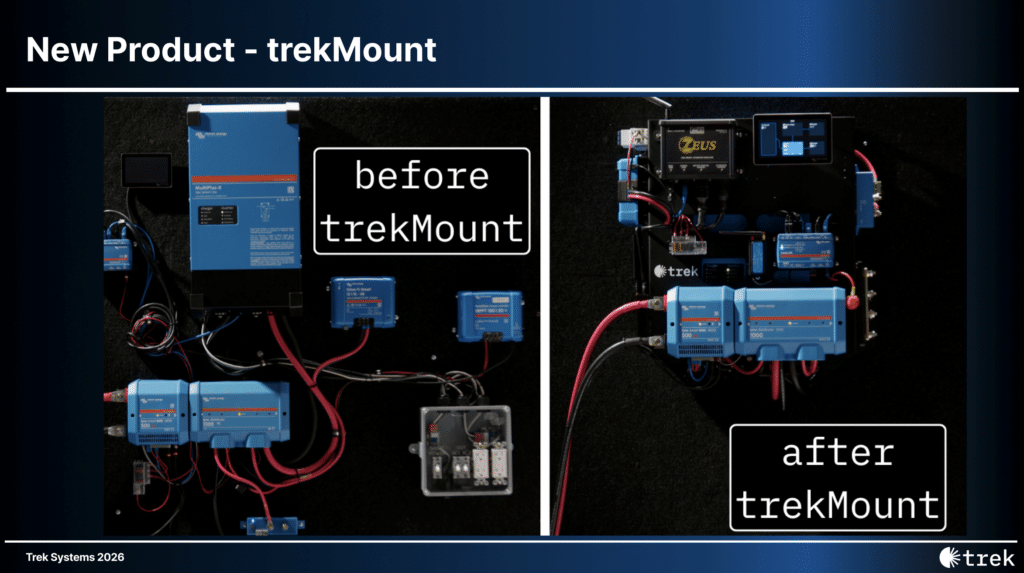
We’re excited to announce the launch of our all in one Victron mounting platform – trekMount. This has been over a year in the making, and we built this because we kept hearing the request for an all-in-one, plug and play Victron system.
End users want to save space. Installers want to save time, and pretty much everyone wants to use the most reliable and cutting edge equipment without being boxed into a one size fits all product.
trekMount works with over 40 components, and installation is very straightforward.
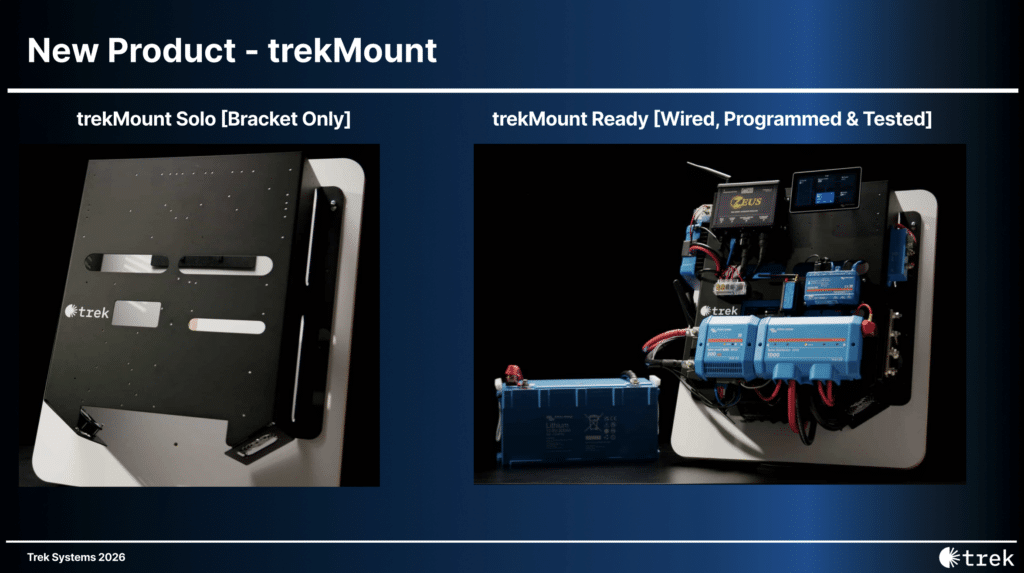
Our two standard options today are trekMount Solo, which is a bracket with threaded mounting holes for all of the common components typically used in a Victron systems. Basically, you bring your own components, mount and wire them up on a bench with our bracket and then install the full system.
The second option is trekMount Ready, and this is the truly plug and play version.
Everything is already mounted, wired, programmed, and tested, so once it arrives, you make some final connections and you’re ready to roll.
Last thing related to trekMount. In addition to trekMount Solo and Ready, we now offer a design, engineering and production service called trekMount OEM.
This is a turnkey service for OEMs and fleet operators. We work with your team to understand the operational requirements. Then we determine the system architecture – energy connectivity, monitoring, and controls. Based on the space that’s available, we then design a custom mounting platform.
We’ve already had successful launches with OEMs. Contact us to learn more.
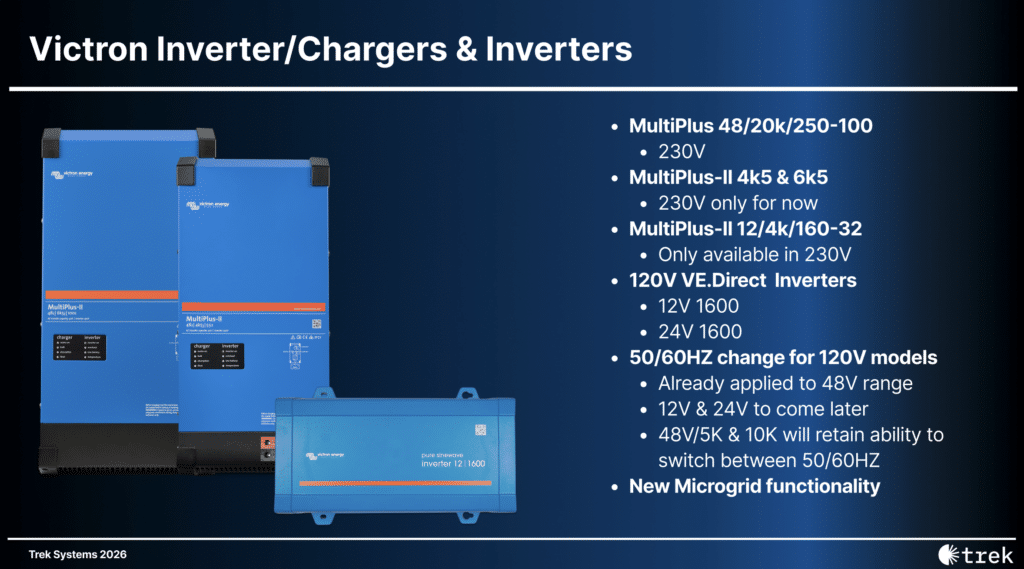
They’ve also introduced new 4500W and 6500W models. The 230V versions are available now, with 120V models expected in the second half of 2026.
One important change — these new units are rated in watts instead of volt-amps, and that update will eventually roll out across the full inverter/charger range to better reflect real output power.
There’s also a new MultiPlus-II 12V 4kVA at 230V delivering 3400W continuous, plus new 12V and 24V 1600VA VE.Direct standalone inverters.
On the 120V side, there’s a compliance change.
To meet UL requirements in North America, 120V inverter/chargers will now be fixed at 60Hz — no more 50/60Hz switching on UL-listed models. This is already in place for the 48V units.
For non-UL applications, Victron will still offer switchable 50/60Hz models — currently the 48V 5K MultiPlus and 10K Quattro, with more to follow.
And finally, Victron is developing a standalone 120/240V split-phase inverter/charger — delivering true split phase from a single unit, instead of requiring two stacked units.
They’ve also introduced new microgrid functionality for battery-based systems, which we’ll cover shortly.
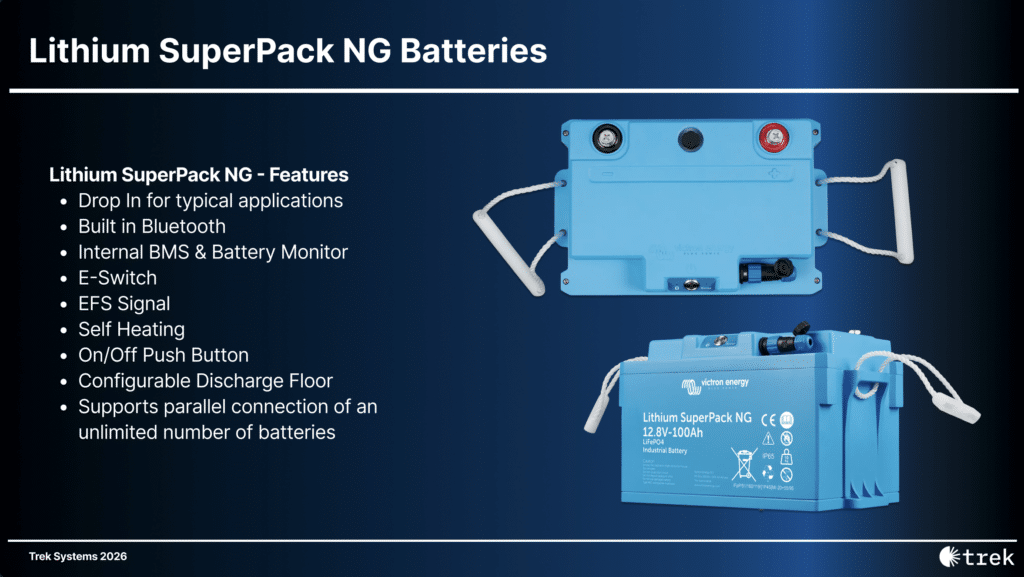
Another exciting new product is the new Victron Lithium SuperPack NG batteries.
This is the next evolution of Victron’s Lithium SuperPack batteries, with new features including; a built-in Battery Management System & battery monitor, integrated heating for charging below freezing, an on/off switch for safe off-season storage, and a new safety vent for gas discharge
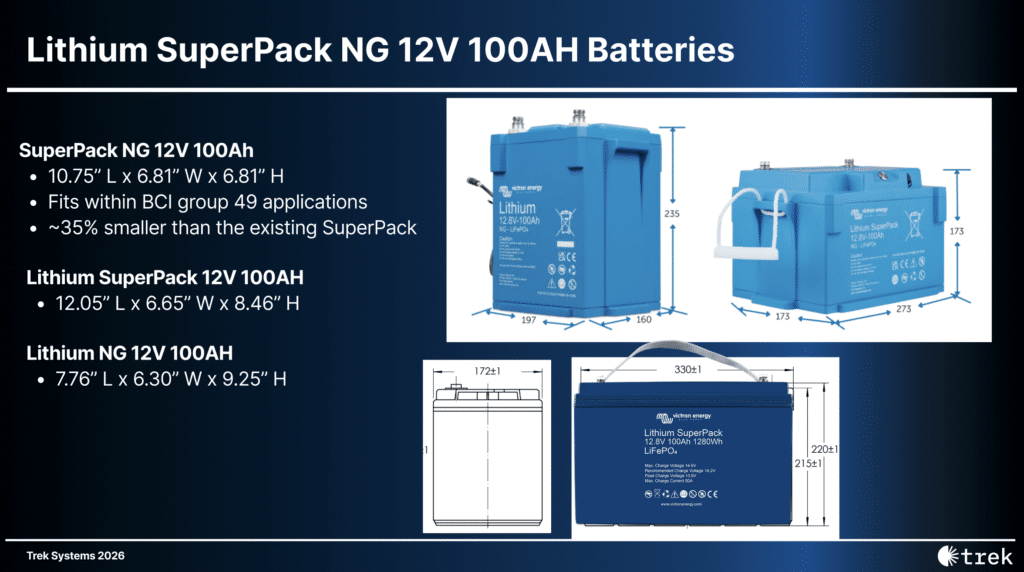
Here you can see the dimensions of the new 12V 100AH Superpack lithium NG compared to the older SuperPack 12V 100Ah battery and the Lithium NG 100Ah battery.
As you can see, the new SuperPack NG is about 35% smaller than the existing superPack battery.
The height dimensions are compatible with the BCI Group 49 standard, this makes the SuperPack NG Ideal for replacement in standard battery compartments.
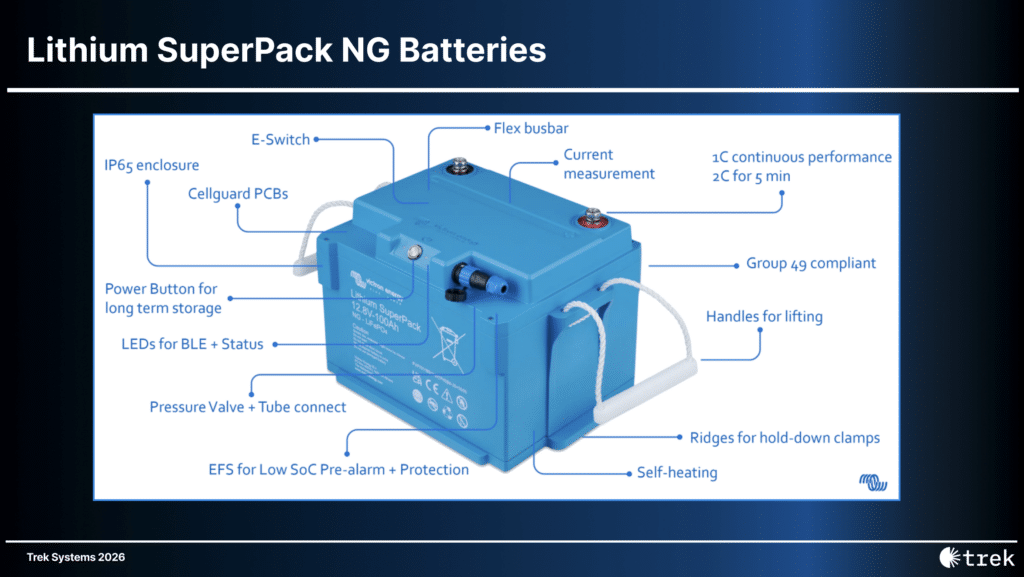
Let’s dig a little deeper into what’s new with the SuperPack NG.
One of the biggest additions is the built-in self-heating function. This keeps the battery above the minimum safe charging temperature, so you don’t run into cold-weather charging issues.
You’ve got two heating modes in VictronConnect.
The default is Charger Mode. In this mode, the heater only runs when a charger is connected and the battery is actively charging. If the cell temperature drops below freezing — 0°C or 32°F — the heater turns on automatically.
The second option is Auto Mode. In this case, the battery will power its own heater to keep the cells above freezing, even if no charger is connected. Just keep in mind this uses stored energy, so once the battery reaches the configured Low SoC threshold, the heater shuts off.
Another nice addition — similar to the Lynx BMS — is the adjustable discharge floor. You can set this in VictronConnect to prevent the battery from fully discharging.
This helps avoid deep discharge and BMS shutdown, which would take the entire system offline. It’s especially useful in applications where recharge timing isn’t guaranteed.
On the mechanical side, like the Lithium NG batteries, these include molded ridges for hold-down clamps — so no straps required.
There’s also a pressure relief safety tube for controlled gas release in extreme fault conditions — that should never be blocked or used for anything else.
You’ve got a physical on/off push button that disables both charging and discharging. When switched off, the battery enters storage mode with less than 3% self-discharge per month.
And finally, two built-in LEDs give you status for Bluetooth, warnings or alarms, and firmware updates.
The SuperPack NG includes an M12 single-pole connector that outputs a simple on/off signal.
The EFS functions similarly to the ATD/ATC outputs on Victron BMS units and can be used to:
The EFS activates when the configured Low SoC warning threshold is reached in VictronConnect and stays active until SoC rises above that threshold.
The wiring diagram shown here illustrates an example using EFS to control a BatteryProtect.
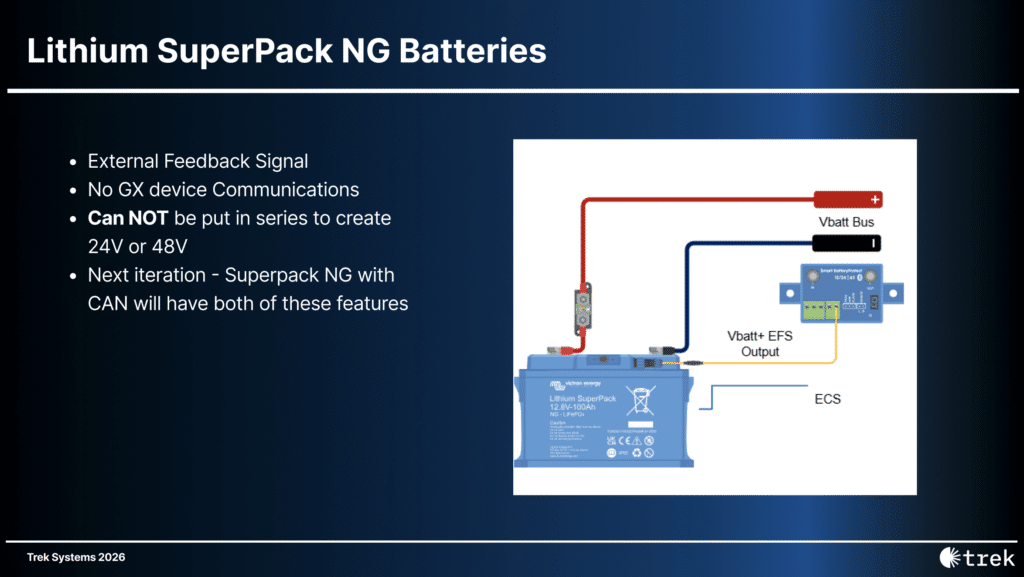
Some limitations of the SuperPack NG batteries to Note:
A future version, the SuperPack NG with CAN, will support GX device and VRM integration and allow series configurations.
Here we can see the full range of Victron SuperPack NG batteries and their expected availability.

The 12V 100Ah, 200Ah and the 24V 100Ah batteries are expected to be available by end of Q1 with the larger 24V 200Ah and 48V 100Ah models planned to follow in Q2.
The next iteration of these batteries, the SuperPack NG with CAN, are expected sometime in the second half of this year.
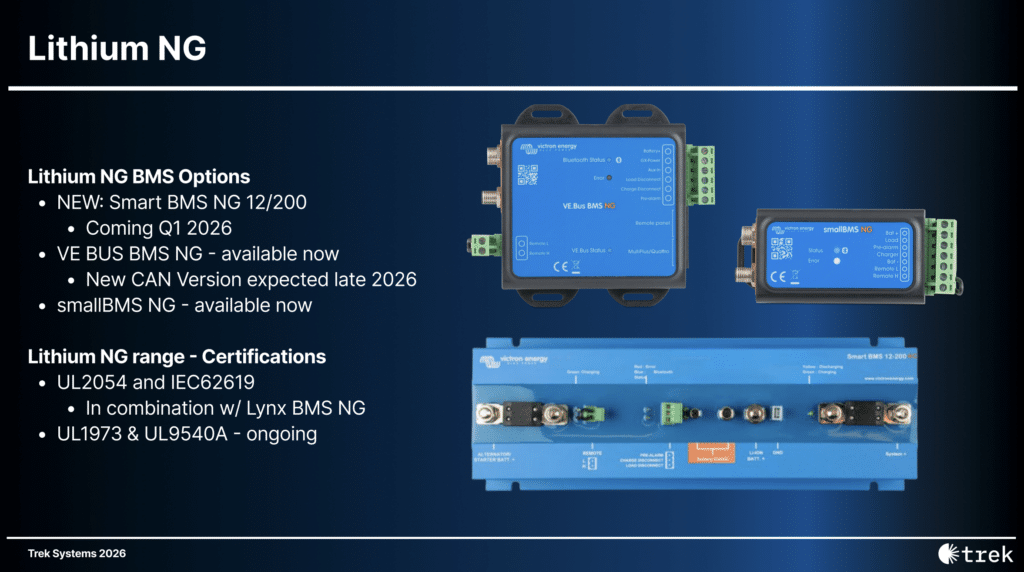
The Victron Lithium NG BMS lineup has expanded — just as a reminder, an NG BMS is required when installing Victron NG Lithium batteries.
The newest addition is the Smart BMS NG 12/200.
This is the next generation of the Smart BMS 12-200 designed for the older smart lithium line, now built specifically for NG batteries.
It carries over the same core functionality — including alternator charging support for 12V systems, built-in current limiting, one-way charging from the alternator to protect it from back feed, and Bluetooth connectivity for monitoring through VictronConnect.
The VE.Bus BMS NG and SmallBMS NG are available now, with a VE.Bus BMS NG CAN version expected later this year.
On the certification side, Victron has achieved both UL2054 and IEC62619 certifications for Lithium NG batteries when paired with the Lynx BMS NG.
UL2054 specifically evaluates the battery pack — including its casing and protective circuitry — to reduce the risk of fire or explosion during operation.
UL1973 and UL9540A certifications are in progress as well, with a few battery models still pending approval.
These certifications are important for RVIA compliance, because the RVIA requires UL listed electrical equipment to meet nationally recognized safety standards for RV certification and labeling. This applies particularly to OEM RV and van manufacturers seeking dealership contracts, since dealers typically require RVIA certification.
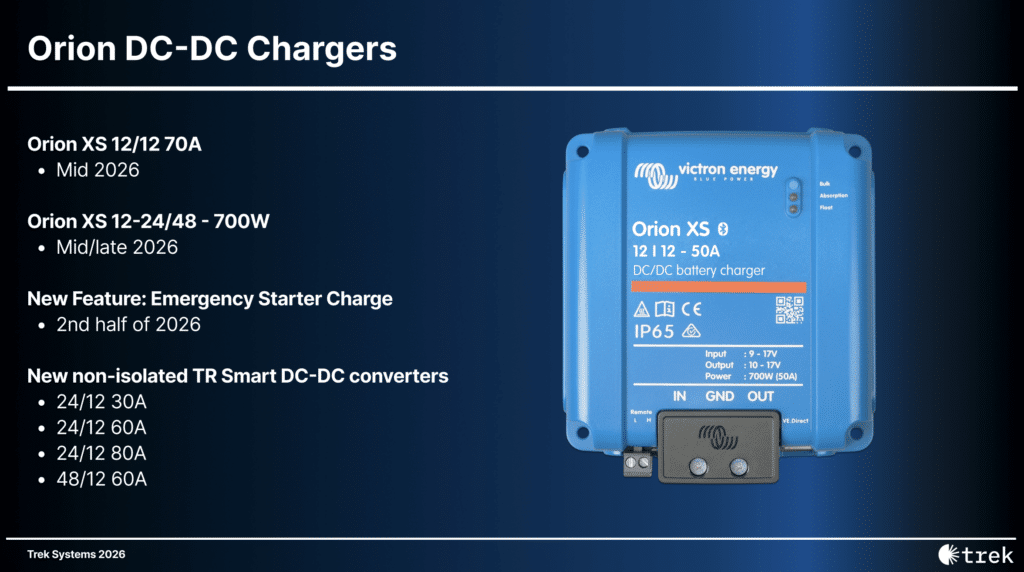
We’re expecting the next iterations of the Orion XS series to arrive mid to late this year, including a 12/12 70A model as well as a 48V-capable Orion XS. These additions will really broaden the flexibility of the XS platform across different system voltages and applications.
There have also been rumors circulating about a future 200A Orion XS. While we don’t have any confirmed details yet, it’s definitely something to keep an eye out for.
Another major update coming later this year is the addition of an emergency starter charge feature to the Orion XS. This has been a highly requested capability, so it’s great to see Victron integrating it directly into the Orion XS line.
Finally, Victron is expanding the non-isolated TR Smart DC-DC charger lineup as well. One of the standout additions is a new 48/12 60A model, which is especially useful for powering substantial 12V loads in an otherwise 48V system. Up until now, the largest DC-DC converter in this category was limited to 30A, so this is a significant step forward.
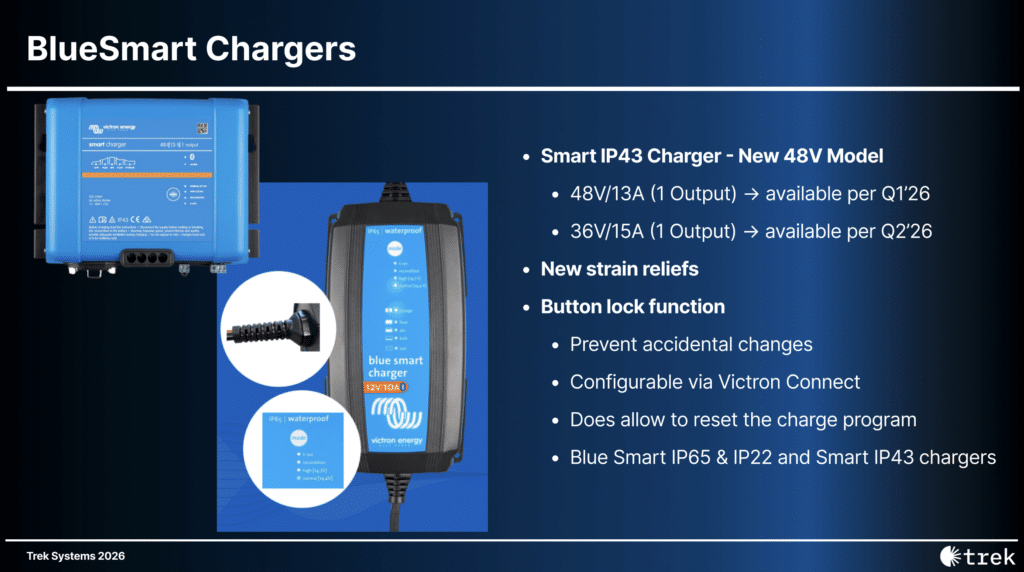
There have also been a few updates to the BlueSmart IP65 chargers.
Newer units, produced since March of last year, now include an improved strain relief design for added durability and cable support.
Additionally they’ve introduced a button lock feature to prevent accidental changes to charger settings.
This update applies across the BlueSmart IP65, IP22, and Smart IP43 charger ranges, adding an extra layer of protection and user confidence.
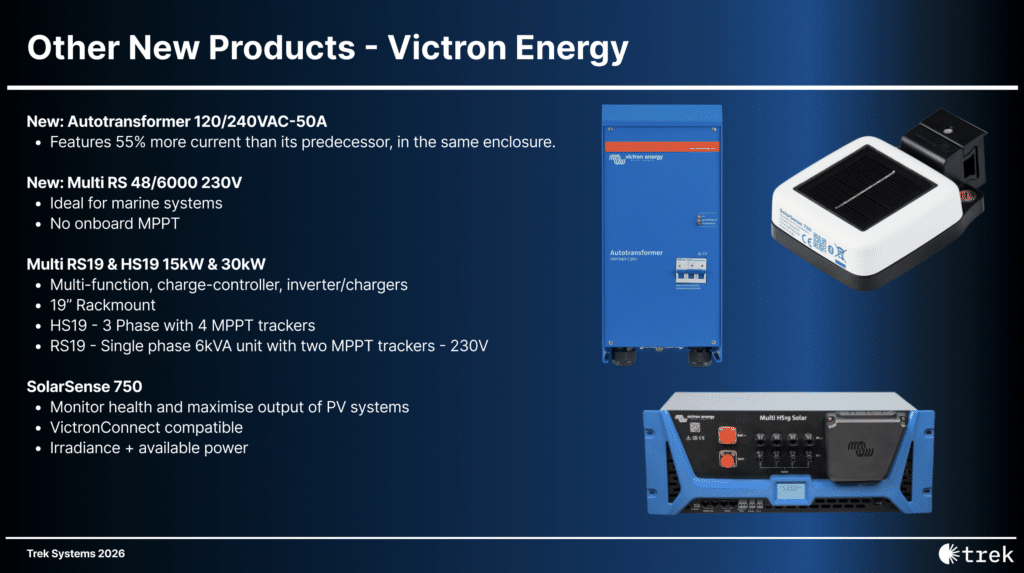
A few additional product updates.
First, the Victron Autotransformer lineup has expanded with a new 50A model. This upgraded version features 55% more feed through current than its predecessor, in the same enclosure.
The Multi RS 48/6000 is now available by request. This is a compact 6000VA inverter with a 100A charger, designed primarily for marine applications.
Unlike other RS models, it does not include a built-in MPPT. That makes it a more cost-effective option for systems that don’t require solar. Currently, it’s available in 230V single-phase input and output only.
Victron has also introduced the Multi RS19 and HS19.
These are 19-inch rackmount inverter/charger combinations with integrated solar charge controllers, making installation much quicker and cleaner.
The Multi RS19 is a 48V single-phase 6kVA unit with dual MPPT trackers built in, while the HS19 is a three-phase model with four MPPT trackers. Both are currently 230V only.
And finally, Victron has introduced a new solar monitoring device — the Solar Sense 750.
This is a wireless Bluetooth device that measures solar irradiance and available PV power. It integrates with VictronConnect and GX devices, and can estimate daily minimum and maximum solar production, as well as daily yield.
It can also be used as a pilot device — helping you evaluate panel orientation, placement, and seasonal performance before finalizing a system design.
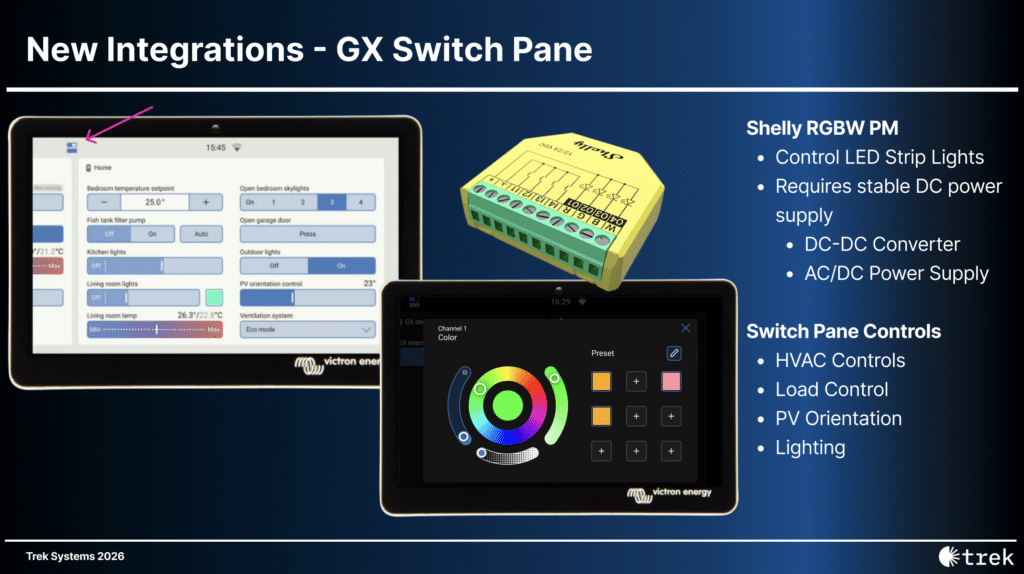
With the addition of the switch pane – Digital Switching now lives on your GX touch screen. Lets take a quick look at some of the things you can control.
Referencing the screenshot in the top left of the slide above, we can set temperature set points for climate control in various spaces, toggle lighting on and off, dim our living room lights to set the mood, and even set our fish tank filter pump to auto so we don’t have to think about it
We can customize the switch pane with 3 types of outputs:
Now lets talk about The Shelly Plus RGBW PM controller. This is now supported to use with your GX device, allowing control of RGBW LED strips from the GX screen. You will find the switch pane in the top left corner of the GX touch display – this is where your controls will live.
This LED controller requires a steady 12 or 24V power source – be sure to use a DC-DC converter or an AC/DC power supply to ensure it operates without issue. With ONE Shelly Controller, you can control up to 4A per channel and 10A total.
You can use the color wheel to change colors and save pre-set lighting scenes.
Connecting to your GX device requires it and the Shelly to be on the same network OR the Shelly can be connected to the GX’s local wifi network – your choice.
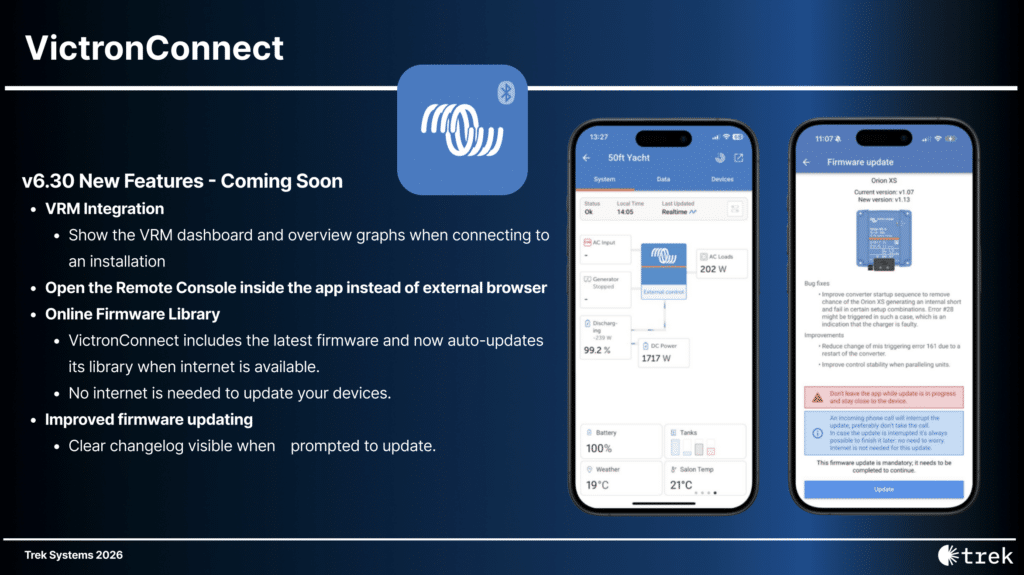
Currently in beta, Victron Connect v6.30 for iOS and Android is getting some updates that really expand our view of the system and the data we can see without leaving the app. When viewing a VRM connected installation, there are three new views – System – Data – Devices.
System view – gives us the system overview – showing how power is moving through out the system. This is a similar view to what we see in the Dashboard when using VRM in the browser. We see our charge devices, DC loads, AC loads, and battery SOC. We even have access to the Inverter/Charger controls allowing us to set the Input Current Limit and Mode.
The Data view gives us some basic system overview graphs like solar production, consumption, or shore power data over time.
The Devices view shows us the GX connected devices – after logging into a device, we can update firmware , settings, and view history data points as if we were on site with the installation. The real treat in this view is access to the Remote Console – directly inside the app – no need to transition to a browser.
Keep in mind – these new views don’t replace the browser based VRM – they present system info quickly – all within the app. For more in depth troubleshooting – the browser based VRM is still probably the right tool.
The app will auto-update its device firmware library when internet is available. As always, this allows you to update local devices without an internet connection.
When updating firmware – the changelog will display right on the update page bug fixes and upgrades listed.
Another exciting feature coming soon, is Batch Programming. This allows you to update firmware and settings for multiple units at one time. This can be a real time saver for folks who deploy multiple of the same units like MPPTs or Orion XS’s.
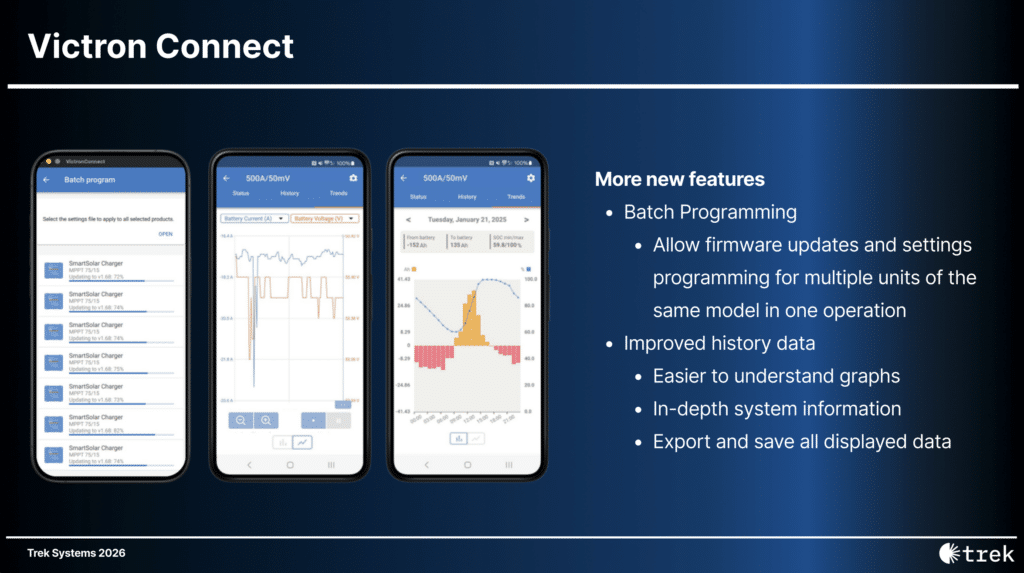
Batch update supports VE.Direct and Bluetooth connected devices.
Data history is also getting some updates.
Trends & History will be more digestible and easier to understand and upack either in the APP or exported and saved.
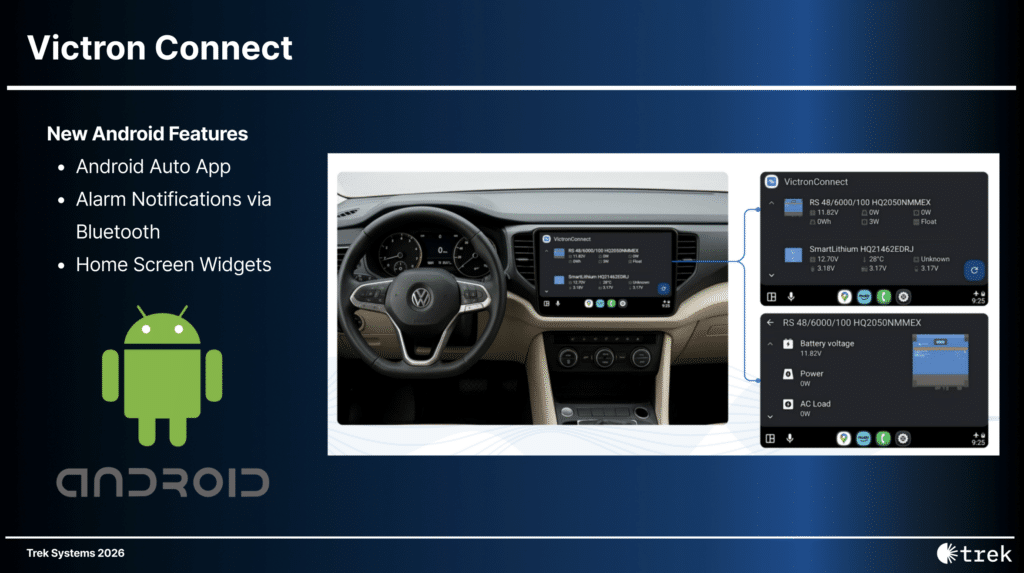
Heres another little clever integration. Victron connect for Android Auto
Android auto is an OS that some EVs use for their display. Now – you can access your Victron devices on the EV alerting you of system alarms and notifications.
You can add your devices here for key information at a quick glance
Now for some VRM updates.
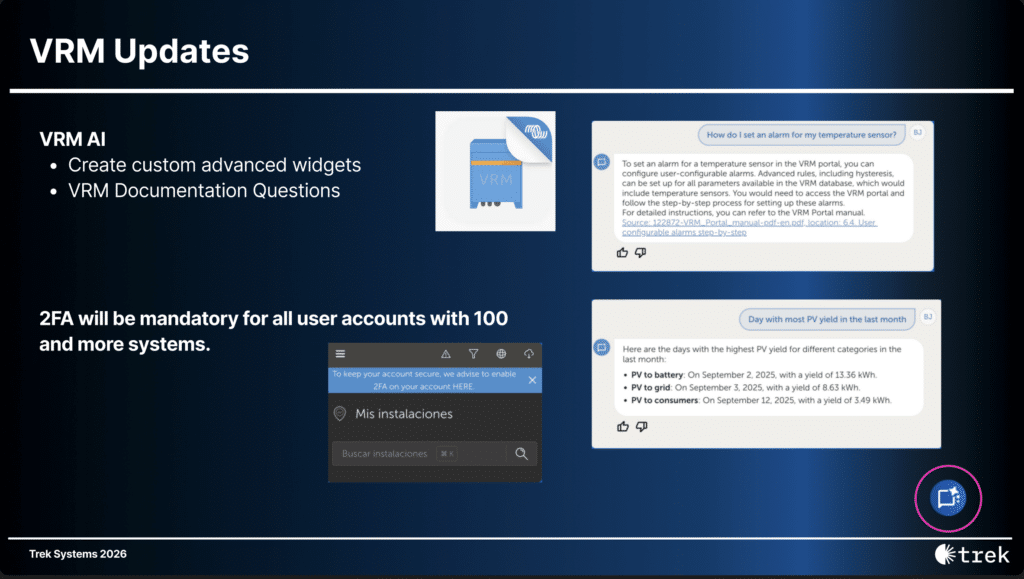
By now, many of you have likely used the VRM AI assistant – This is for the Browser based VRM – you will find the button on an installation’s Advanced Page at the bottom right corner – just like on this slide, circled in pink.
With a prompt, this assistant generates custom data graphs – allowing you to view specific information from discrete devices overlayed on a single graph.
Now – this assistant has the ability to answer VRM documentation questions and system summaries – helping you to create a tailored VRM experience. For example, “How do I set an alarm for a temperature sensor?” or “What day had the most PV yield last month”.
For accounts with more than 100 systems connected – 2 factor authentication will be mandatory, keeping your and your client’s data secure.
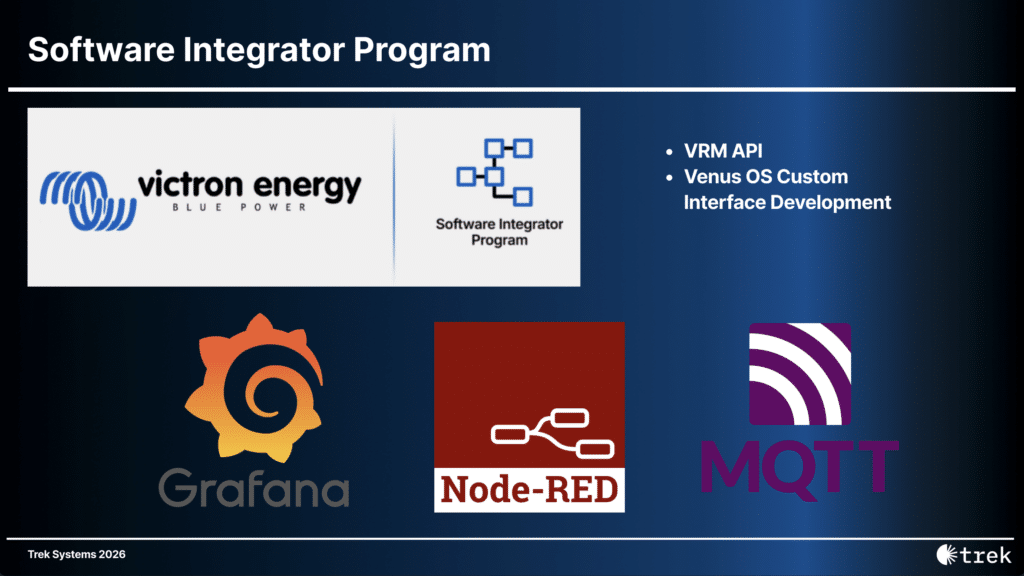
The Victron software integrator program was created to accelerate the development of practical, customized solutions that bridge the Victron eco-system with some of these other integrations, custom monitoring, and automation platforms.
A few examples of what a software integrator might do include, using the VRM API to send data to a custom dashboard, or tapping into the bluetooth messaging of a Victron device and placing this data alongside other vehicle telematics data for fleet monitoring. Adding a page on the GX Touch to display custom tiles with data like ‘shore power quality’ or generator fuel usage estimates or working on a new RVC device integration, like how you can view data on a touch screen from a SeeLevel Soul tank monitor or Arco Zeus alternator regulator.
Really the sky is the limit with Victron, and it’s not a matter of can we do it, but how do we want to do it. We’re proud to announce that our team is a member of the software integrator program, so let us know if you have an out of the box ideas or custom use case we may be able to help with.
What is a microgrid, and how is it different from other battery-based energy systems?
The definition of a microgrid varies depending on who you ask. Our favorite definition comes from the Advanced Microgrid Design course offered by SEI, which states a microgrid includes interconnected power generation, energy storage, and loads shared by multiple buildings, sites, or services, contained within a clearly defined electrical boundary. They go on to say that a microgrid may be grid connected (or utility interactive), but has the ability to operate independently (in what’s called Island Mode) when the utility grid is not present or offline.
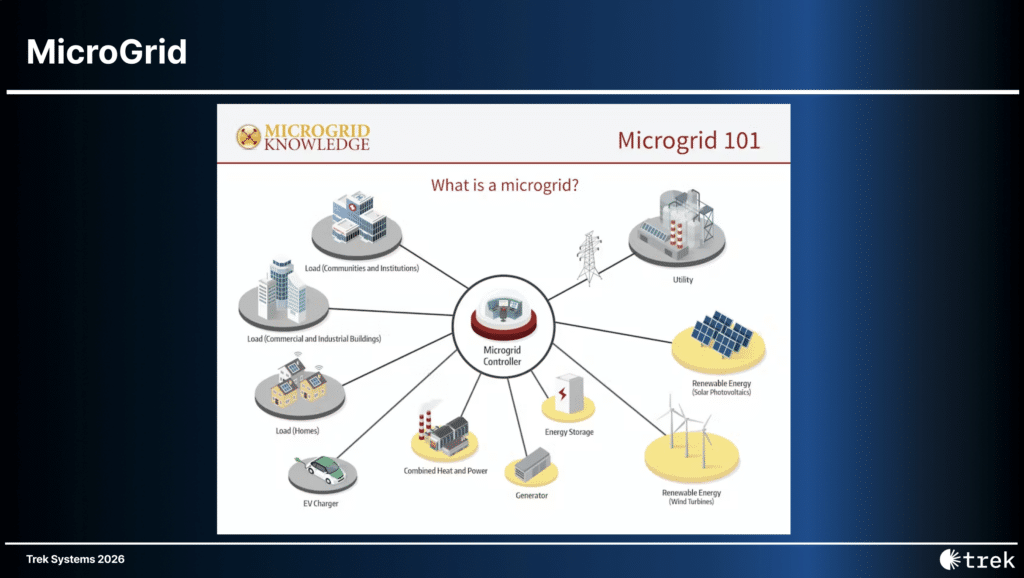
Now, when we talk about Microgrids in the context of using Victron equipment, the idea is that we can now allow smaller systems to work together in parallel to support larger load demands.
For example, you might have a trailer with an energy system designed to provide power for a small event. Let’s say you build a few more trailers so that you can support more small events. But then an opportunity to support a large event arises. Well now, you can take all of your small trailers, combine them in parallel, and provide sufficient power to support the larger load demand of this large event.
Other examples where this microgrid capability might be useful include Remote communities, construction sites, disaster relief, command centers, data centers, military FOBs, and the list goes on.
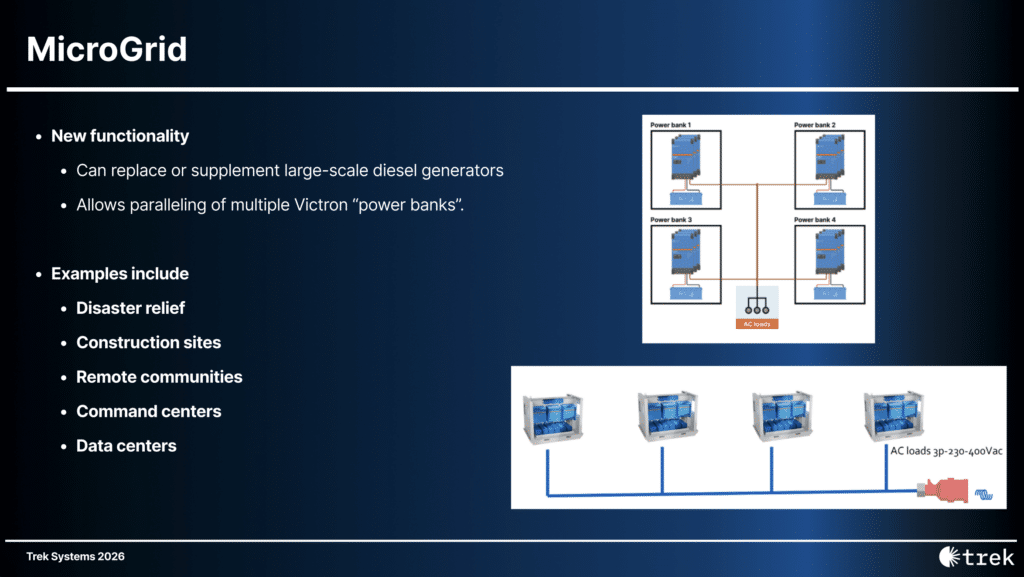
So the biggest takeaway here is that Victron systems can now scale to be much larger, while also allowing for considerable redundancy, because if one power bank drops offline, you have the other power banks running to keep the lights on.

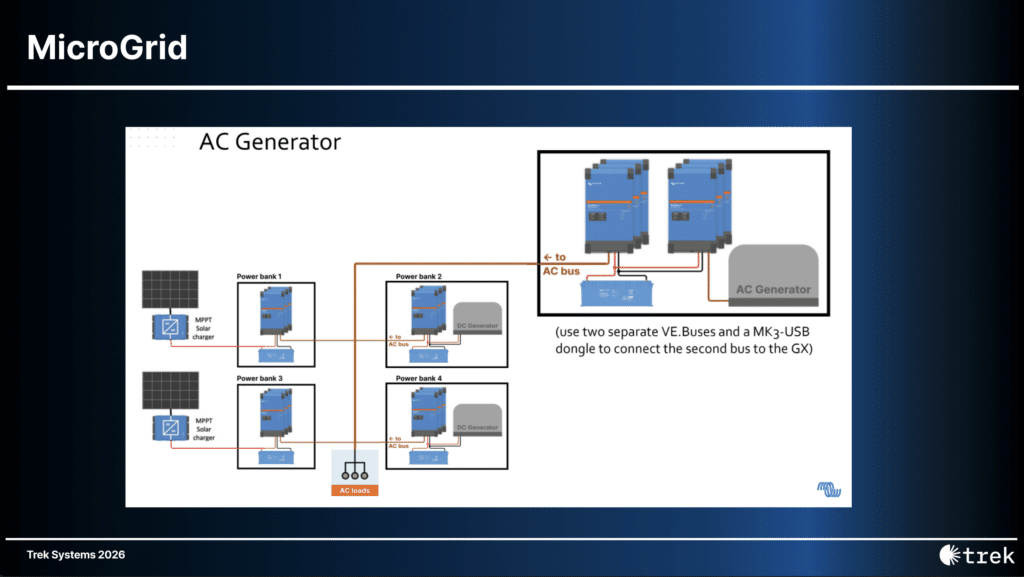
In this example, we have a traditional AC generator in the top right corner, with a Victron system there to supplement. Let’s say an industrial campus wants to expand without needing to completely revamp their energy system.
Well now you can drop in these additional power banks, some utilizing solar, and others with a DC generator backup, and all will work together to support the same AC load requirement.
And the icing on the cake is that you do not need to run additional communications cables to get these power banks in sync.
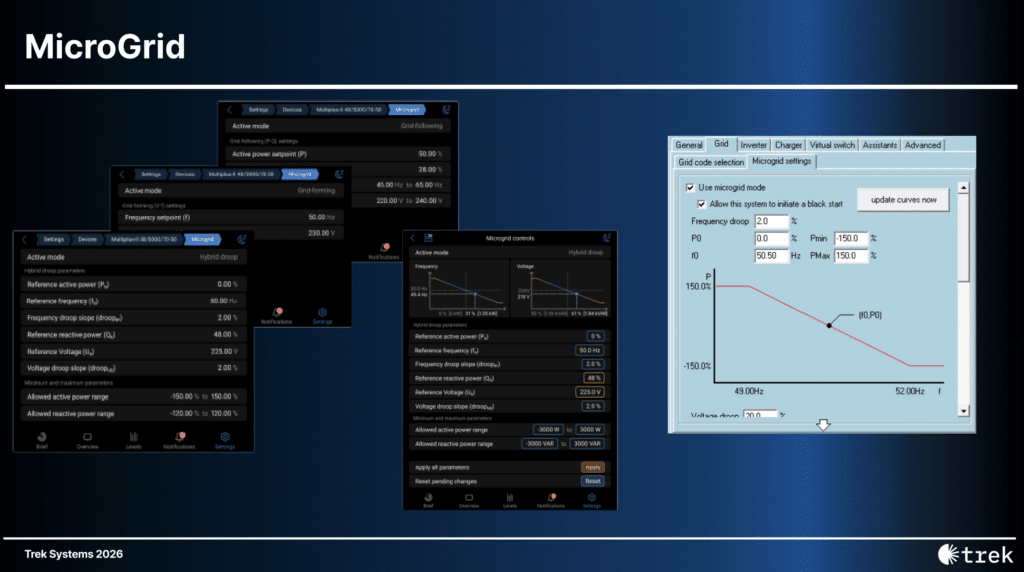
Traditionally, microgrids utilize a complex and expensive energy management system (or microgrid controller) to keep all of the nodes in the network on the same page. Kind of like a GX device, except instead of managing one system, the EMS manages multiple independent systems like those shown in this example.
With Victron, instead of requiring this additional management overhead, the power banks are actually able to synchronize with each other based on AC frequency and voltage.
What really makes this possible is a feature called Hybrid droop mode, which adjusts power output based on frequency and voltage deviations.
As the load increases, the frequency drops, and the inverter increases its power output accordingly.
So each inverter can respond independently to the grid conditions, allowing them to share loads proportionally based on the droop characteristics.
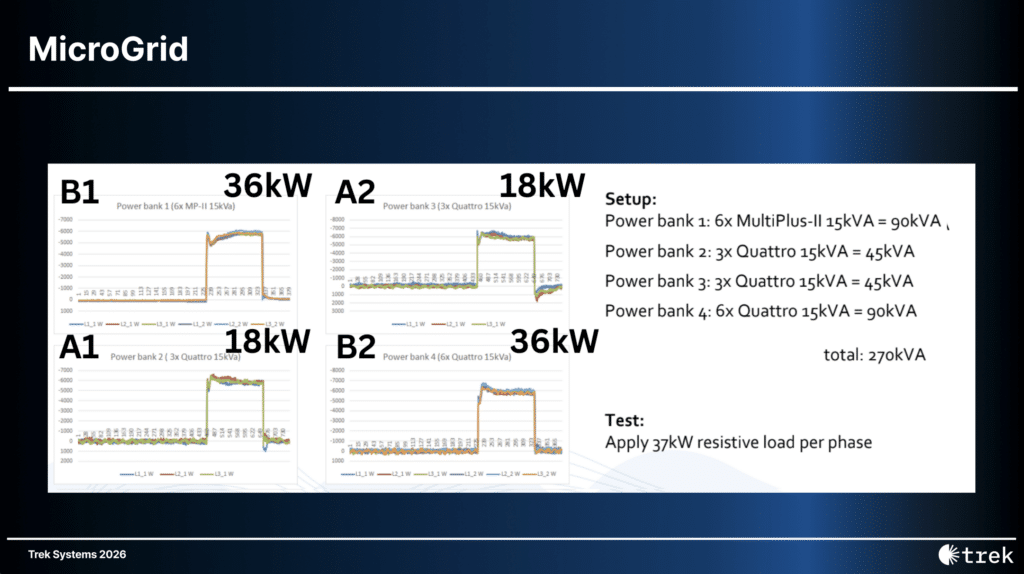
This is a test published by Victron that shows all of this in action. They setup 4 power banks to support a three phase system. Two power banks rated for 45kVA, graphs A1 and A2, and two power banks rated for 90kVA, graphs B1 and B2. You’ll notice that the main difference in these graphs is the number of colored lines, where each line represents a single inverter, so you have 3 inverters in each A graph, and 6 inverters in each B graph.
They then applied a 37kW load to each phase, so that’s 111kW in total. And without any additional communciations cables between these power banks, they all adjusted their output so that it was proportional not only across each power bank, but across each inverter within each system.
A quick note that these numbers are rounded and don’t equal 111kW exactly, but look at how all the lines match up to show that every inverter in this microgrid, all 18 of them, are outputting equally at around 6kW.
And also that powerbanks B1 and B2, because they are twice the size as A1 and A2, are automatically outputting twice as much power.
So it’s proportional, all inverters are being loaded equally, which means no one point in the system is being overly stressed, and that’s important of course because over stress could lead to premature failure.
Victron has some of the most robust and reliable components out there, and this test demonstrates that, not just at the component level, but at the system level, they have this same commitment to reliability.
Thanks for joining us in this blog post. If you have questions about anything we’ve shared, get in touch to discuss. You can also view the full webinar on YouTube: